Posts in Architecture
S N O W C O U N T R Y

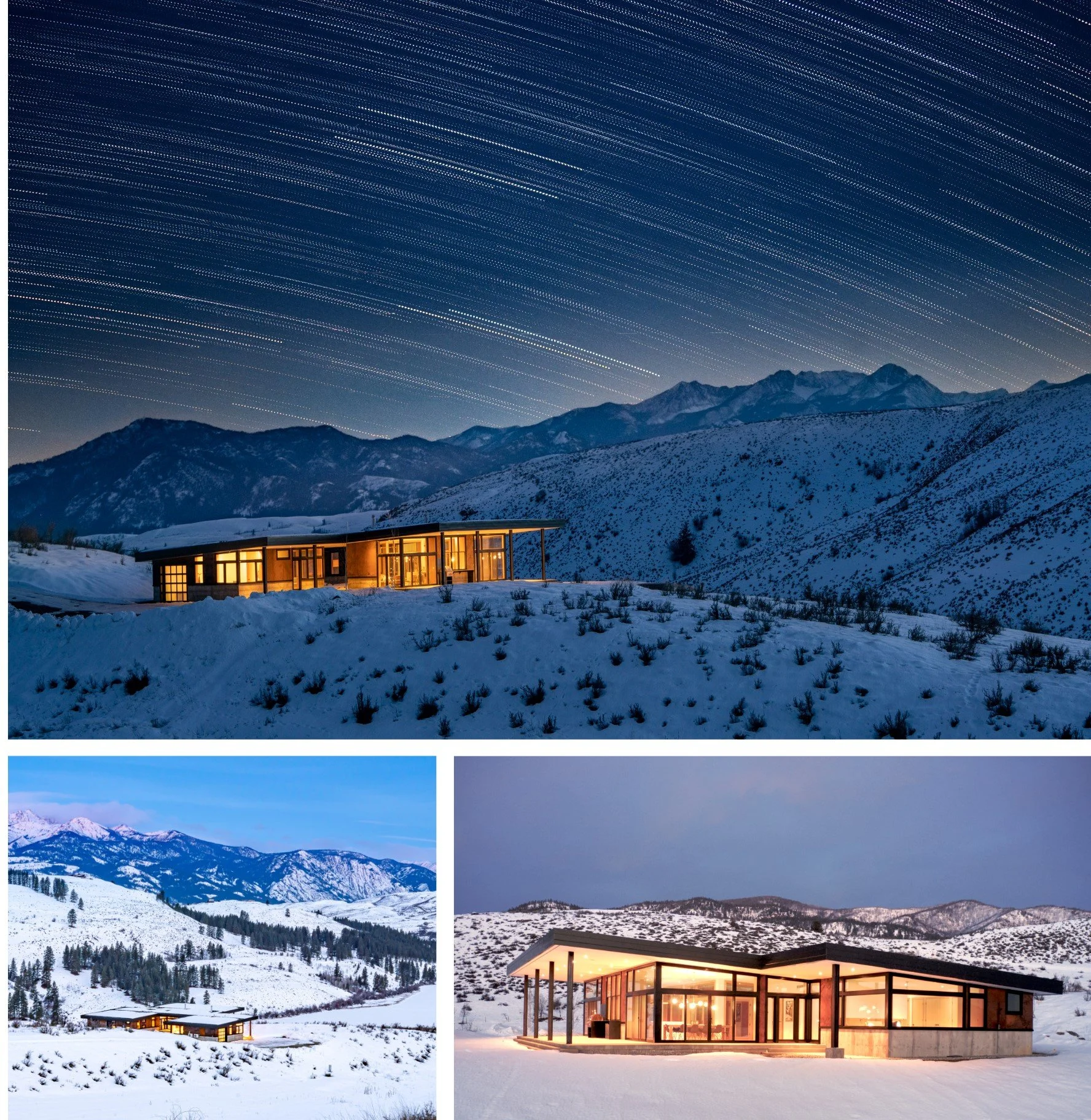
The straightforward roof design of this home is designed for its rugged environment in Washington’s Methow Valley. We kept it simple and avoided complex shapes—a roof that holds snow reduces the chance of slough off and provides an energy-saving bonus.

Deep eaves and generous covered walkways and entries help keep outdoor circulation free of ice, reduce shoveling, and simplify living.

Roof Design in snow country

Plan a simple, generous roof that will hold snow and cover outdoor walkways, entries, and deck areas.

-  A blanket of snow on the roof provides a free, insulating, energy-saving bonus.

-  A roof that holds snow reduces the chance of avalanche, creep, or slough off and minimizes chance of injury or damage to the structure.

-  Plan for the roof to cover four-season outdoor living areas.

-  Keep the roof simple—avoid complex shapes, valleys, and roof-to-wall intersections.

-  Avoid gutters as meltwater can create ice dams at eaves and accumulate in gutters resulting in maintenance issues.

-  Avoid skylights, and roof penetrations when possible. Roof vents, chimneys. and plumbing vents should account for snowpack.

Photos: Built Work Photography

ON THE BOARDS – CAST designs Multi-family housing in Eastlake

Seattle Architect pursues passive house certification with missing-middle housing on Lake Union

Echo on Eastlake apartments is pursuing Passive House certification, with early design and feasibility studies complete on the new 10-unit apartment building in Seattle’s Lake Union neighborhood.

This building will replace an existing single-family structure in this residential urban village, adding missing-middle housing. It utilizes the stacked flats concept which pushes the bounds of the single-family envelope but maintains an urbanism-friendly street frontage. There is one central stair and no shared walls. And, the two homes on the ground floor are both fully accessible.

Six-to-twelve-plexes offer a superior urban experience, more housing units, more housing variety, and at least some fully accessible housing units. They also may preserve more tree canopy, increase open space, and optimize daylight compared to townhomes.

More to come in the months ahead.

TEAM
Developer: West Crescent Advisors, LLC
Owner’s Representative: Woodworth Construction Management LLC @woodworth_built
Architect: CAST architecture
Builder: Carrig Construction
Civil Engineer: Davido Consulting Group
Landscape Architect: Karen Keist Landscape Architects
Arborist:  Moss Studio
Geotechnical Engineer: Pangeo, Inc.
Surveyor: Terrane
Structural Engineer: Harriott Valentine Engineers
Envelope Consultant: B.E.E Consulting

CAST is Hiring - join our team

Seattle architect hiring

Current Opportunities:
Design Associate with 2+ years of experience
AND
Project Architect/Manager with 5+ years of experience

CAST Architecture is a Seattle-based firm with extensive experience designing contemporary spaces throughout the Northwest. Specializing in modern and sustainable projects, the firm is committed to improving the lives of individuals, families, and the community through vibrant and thoughtful design. We are inspired by collaboration, intend on crafting timeless, high-performance buildings, and are committed to positive social outcomes.

Our studio environment is friendly and low-key. We enjoy working collaboratively and actively foster a team approach in all of our endeavors. We pride ourselves in promoting a healthy work/life balance and passions and interests outside the office. While we’d love to have everyone in the office working together, we support flexible remote-work scheduling.  

DESIGN ASSOCIATE

Job Description
The candidate will work under the leadership of a licensed architect/project manager and will assist with all aspects of the design and production of residential, commercial, and public architectural works. Additional duties will include general administrative tasks and assisting with the production of marketing materials as needed.

Experience with documentation and delivery is a big plus. We’re always working on several tenant improvements, early learning centers, and custom residential work that require collaboration, creativity, and attention to detail.

Qualifications

• First and foremost you are an exceptional designer who excels working in a collaborative and creative environment

• A ‘can do’ work attitude on all tasks from the mundane to the extraordinary

• Solid verbal, written, and graphic communication skills

• A well-rounded understanding of the technical aspects of architectural design including materials use, construction techniques, and construction details

• A Bachelor’s or Master’s degree in architecture or interior design from an accredited university is required

Technical skills

• Proficient with architectural BIM software, preferably ArchiCAD (Note – we do not use Revit/AutoCAD). We will train if you don’t have ArchiCAD experience but are ready to learn.

• Familiar with Affinity/Adobe design products, Bluebeam, and Microsoft Office.

• Capable of producing high-quality renderings with Lumion is a plus but not required.

Benefits

  • Flexible schedule, remote work

  • Competitive compensation

  • 401K+3% employer match

  • Health, dental, and vision insurance

  • Overtime pay

  • Annual bonus

  • Support for professional development and certifications

Submit a cover letter, resume, and samples of design work digitally to employment@castarchitecture.com. We will review and contact applicants on a rolling basis in January.


PROJECT ARCHITECT/MANAGER

Job Description
The immediate need is to work on a range of housing projects, including affordable multifamily, market-rate infill, custom houses, and institutional projects.  Our projects are staffed with small fluid teams, usually with a principal, project architect and one or more design associates. After a collaborative schematic design, the project architect leads design development, consultant coordination, construction documents, permitting, and construction administration, while managing additional staff as necessary to complete the project.

Qualifications

  • First and foremost you are an exceptional designer who excels working in a collaborative and creative environment

  • A ‘can do’ cooperative attitude

  • Highly organized project management

  • Solid verbal, written, and graphic communication skills

  • A well-rounded understanding of the technical aspects of materials, methods, energy use, and construction details

  • 5+ years experience

  • A Bachelor's or Master's degree in architecture from an accredited university is required

Technical skills

  • Proficient with architectural drafting software, preferably ArchiCAD (Note – we do not use AutoCAD).  We will train if you don’t have ArchiCAD experience but are ready to learn. 

  • Proficient with Bluebeam, and Microsoft Office suite. 

  • Capable of producing high-quality renderings with Lumion would be a huge plus but not required

  • Certification in Passive House or LEED, energy modeling, and experience with sustainable construction systems and methods.

Benefits

  • Flexible schedule, remote work

  • Competitive compensation

  • 401K+3% employer match

  • Health, dental, and vision insurance

  • Overtime pay

  • Annual bonus

  • Support for professional development and certifications

Submit a cover letter, resume, and samples of design work digitally to employment@castarchitecture.com. We will review and contact applicants on a rolling basis in January.

No phone calls or hand-delivered applications, please.

Making “Plexible” Projects Possible
Jansen Court, missing middle housing, Seattle Housing

Courtney W. Banker’s report Making “Plexible” Projects Possible includes research and examples from Seattle architect Matt Hutchins

Missing Middle Housing — Why Stacked Flats?

Stacked Flats push the bounds of the single-family envelope but maintain an urbanism-friendly street frontage. 6-/12-plexes offer a superior urban experience, more housing units, more housing variety, and at least some fully accessible housing units. In Matt Hutchins’s design approach, 6-/12-plexes also preserve more tree canopy, increase open space, and optimize daylight compared to townhomes.

Stacked flats can feature one or even four fully accessible units on the ground floor—without the need for an elevator (a significant cost too burdensome for most small-scale projects). They are a powerful incremental development strategy that can be replicated to result in substantial change, helping neighborhoods grow with more sustainable land uses, urban-supportive density, and accessible housing units.

This report builds on prior efforts to promote missing middle housing in Austin, Texas, leverages interviews with 23 local and national experts, and employs financial modeling of for-rent projects to identify the key barriers facing stacked flats.

The report is at the University of Texas Scholar Works: https://repositories.lib.utexas.edu/handle/2152/115590

@Courtney Banker
@Matt Hutchins AIA CPHD

cast's community design in the methow valley
mazama public house, methow valley, community design

Mazama Public House at the north end of Washington’s Methow Valley

mazama public house in the Methow valley community

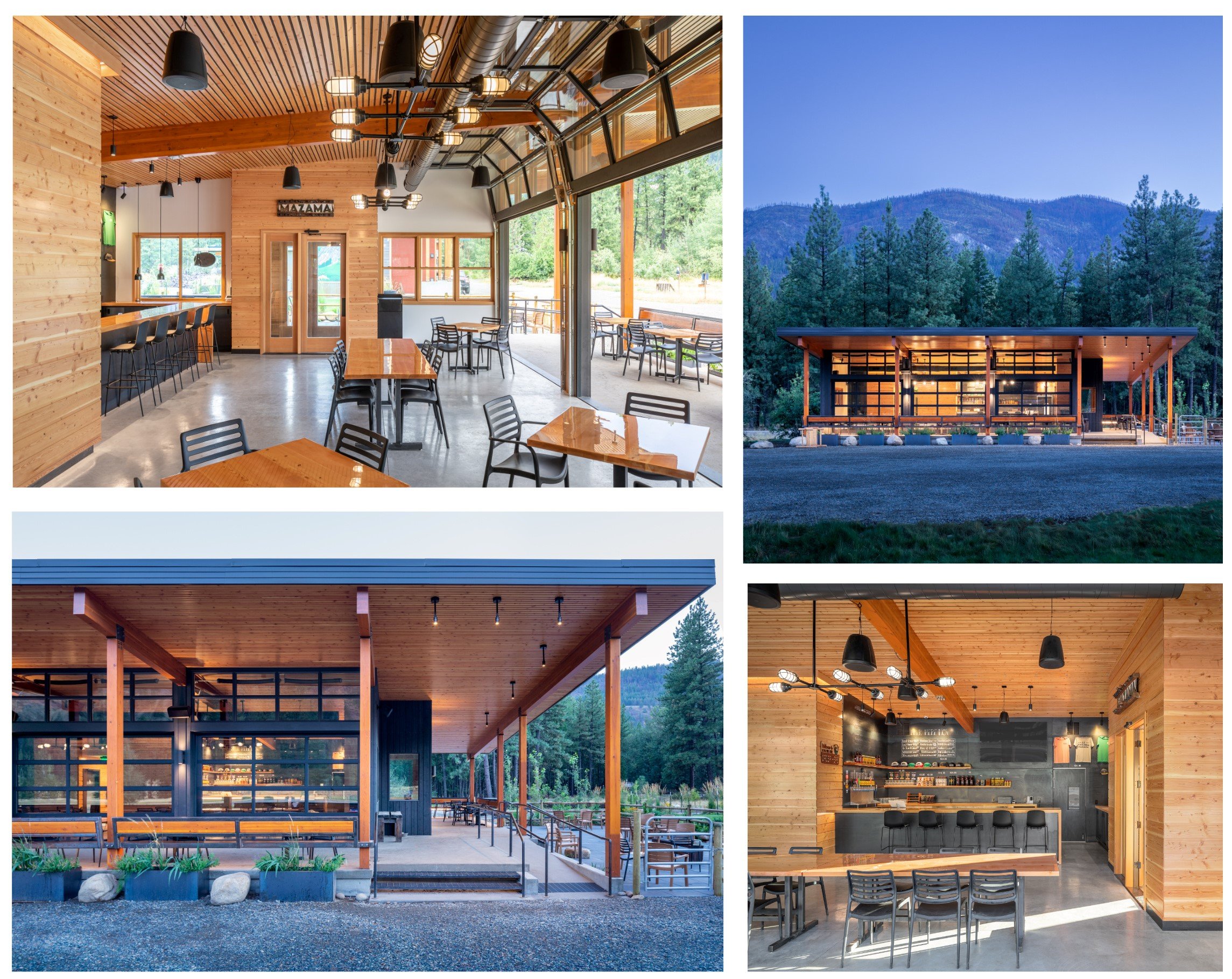
The Mazama Public House is set to become the gathering spot for the community of Mazama, at the north end of Washington’s Methow Valley. Oriented toward Goat Peak mountain views, the 1,868 square foot public house is designed to seat 56 and another 50 outside with built-in benches on the four-season covered patio.

An expansive three-door door system opens in the summer months for a seamless connection to the outdoor decks. The indoor area incorporates performance space, and the large garage doors allow for flexibility and increased seating capacity. The height of the shed roof and the expansive windows on two sides are sited to take advantage of natural light and views. The interior features wood beams punctuated by blackened steel and concrete floors. Custom tables and bar slabs were crafted from locally sourced Douglas-fir. Outside, blackened steel will accent the wood structure. The siding is a dark-stained, rough-sawn vertical channel shiplap.

See more on our website.

Photos by: Benjamin Drummond Photography www.benjandsara.com

CAST designs missing-middle housing in capitol hill
Seattle, missing middle, urban density

Jansen Court missing-middle housing in the Capitol Hill neighborhood of Seattle.

Seattle architect designs missing-middle housing

Jansen Court Apartments is a Built Green 4-Star 10-unit studio apartment building on the back of a 30’ parcel in Capitol Hill, preserving a turn-of-the-century house in the front yard.

With a single stair, this 4-story apartment building was quite the puzzle -- the complexity of regulations are magnified on a small project. Each level is different, with a basement, typical story, vaulted story, and unit with roof access. They're small, 400-600 SF, but nicely livable spaces.

And, it’s in Capitol Hill with a pretty street and bustling neighborhood. Walk Score: 92!

CAST is closely associated with efforts to improve housing affordability through increasing the “missing middle” moderate density infill within existing neighborhoods.

Photo credit: @lensit.studio

A Lakeshore home maximizes its site and views
lakefront home, lake views, living room

SEATTLE architect MAXIMIZES lakefront SITE

This full renovation adds space to support dynamic family life—places to work, play, entertain, and exercise. Programmatic additions include a second-floor music room and a third-floor family/media area opening up through a ghost door to expansive views, a kitchenette, a small gym, an office, and a pocket art studio. A bright, double-volume wall of glass in the staircase seamlessly connects floors and is topped with a skylight.

The kitchen’s neutral palette includes soft-close, white oak cabinets with custom panel details, honed quartz countertops, and a solid surface backsplash. A landing on the second floor offers a special moment to enjoy the green roof, with abundant daylight from glazing and a skylight, before entering the music room.  Glazing and outdoor living spaces allow the architecture to feature the views of Lake Washington.

Interior Design: Hyde Evans Design
Built: Align Builds
Photos by: Andrew Giammarco

See more here.

interior living room, art nook, lake views
lakefront home, lake views, living room, dining room kitchen lounge
Can I be more sustainable by living in a tiny home?
Seattle DADU, kitchen, backyard cottage, interior

A Seattle Detached Accessory Dwelling Unit

Sustainable living in a tiny home

CAST is featured in Porch’s round-up: Everything About Tiny Living: Tips From the Experts

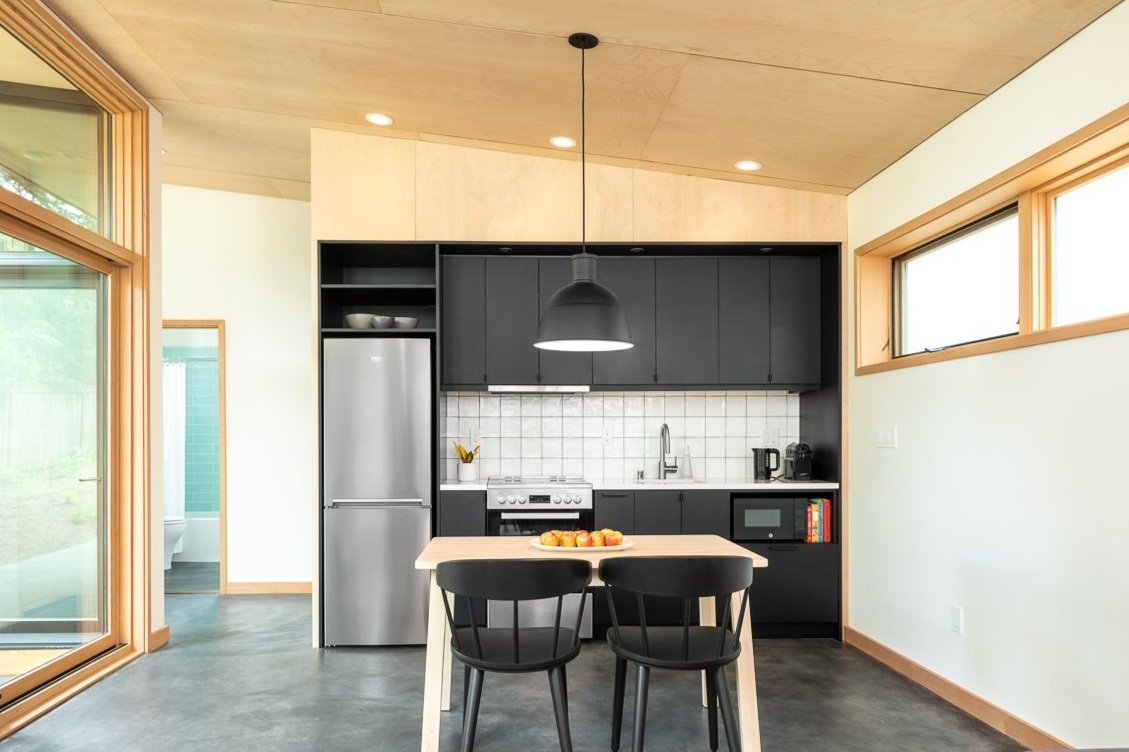
We are rethinking space and home. CAST believes tiny homes, accessory dwelling units (ADUs), and backyard cottages are inherently sustainable building options, as well as sensible answers to the housing crisis. Tiny homes require fewer materials to build, create less waste, and use less energy to power, heat, and cool when compared to traditional single-family houses. 

In addition, people who live in tiny houses will own fewer possessions and spend less overall. Downsizing will influence lifestyle in many ways—streamlining possessions, becoming more mobile, and building financial security—which leads to a lower carbon footprint. Typically, as one moves into a tiny home, other segments of life change positively as well including overall consumption of goods, services, and even food. And this, in turn, reduces the impact on the environment. Specifically, with carbon footprint in mind, the factor that will have the most impact is the size of the home.

Good design matters. Our backyard cottages are designed to be energy efficient, low cost, and built for privacy within their context. Daylighting is important in every home and especially in small spaces. Effective storage is essential. Layering and overlapping are key to designing successful small spaces while using different materials will create well-defined areas. Plan to maximize every square foot in common living areas and integrate outdoor space. Covering outdoor space makes it feel like an extension of the home, without having to heat or cool it.

Density and more efficient land use are critical to addressing our housing crisis, climate change, and persistent inequities in access to housing. Modest infill houses like tiny homes, ADUs, and backyard cottages are a key strategy to empower citizens to provide new housing, build generational wealth, and leverage taxpayers’ investment in infrastructure, transit, schools, and parks. Plus, these homes could create an affordable housing inventory.

Photo, above: Cindy Apple Photography
Photo, below: Benjamin Drummond Photography

sustainable tiny home,  Methow Valley

A functional and sustainable tiny home in Washington’s Methow Valley

See more of this tiny home on our website.

this Mercer Island Home Brings in the outdoors
interior, living room, kitchen, dining room

this mercer island custom home brings in the outdoors

With neighbors close by, this home on Mercer Island is organized into two solid masses flanking a glass box that acts as the gathering area. An open staircase ties the levels together and a bridge links bedrooms upstairs and allows for a vantage point to the living room below and the backyard tree canopy. With glass doors and large stacked windows, the main gathering area is linked to the outdoor patio and beyond to the forested green space. The exterior materials are accentuated by wrapping into interior spaces. The dining room, kitchen, and large walk-in pantry offer intimate spaces, with a strong connection to the two-story living space. The pantry, with plentiful storage, can be closed off from the open kitchen and casual eating area.

See more in the Homes section of our website.

Photos by: Andrew Giammarco

URBAN DENSITY In Seattle’s Montlake neighborhood
Seattle ADU, DADU, missing middle housing

A modern Tudor-style cottage built to fit the neighborhood and add density to Montlake

DADUs help seattle’s density

This well-crafted modern Tudor-style cottage in Seattle’s treasured Montlake neighborhood brings forward a model of urban density, while providing a private home. A gracious entry brings you to the great room with vaulted ceilings, dark-wood beams, and loads of natural light from all four sides of the home. The kitchen is designed with abundant easy-to-use storage and generous counter space. The dining area’s large glass doors open to a patio facing inward to the property’s shared courtyard that connects the private homes and provides opportunities to gather. A lot of home fits into the 1,225 square feet with three bedrooms, two baths, flexible utility space, and creative storage. Two entrances make access to both levels of the home straightforward.

See Built Green’s case study on their website: CAST architecture Modern Tudor DADU It highlights energy efficiency, low-impact development, rainwater catchment, indoor air quality, moisture protection, and materials with reduced environmental impact throughout the home and property.

See more: Blaine Cottage

Photos by: Andrew Giammarco

A pair of CABINs-on-wheels clad in shou sugi ban charred-wood are modern and ultra-functional
tiny homes, shou sugi ban, methow valley

Modern, functional shou sugi ban clad tiny homes on wheels in the methow valley

Like some who found themselves in lockdown at the start of the Covid-19 pandemic, this Seattle family of four realized if they were going to work and attend school online, they could do it from anywhere. Cue a temporary move to their summer place. A year into their stay, they decided they were putting down roots in the Methow Valley and decided to make the change permanent. Their out-of-the-box solution? The family spent the summer building a pair of tiny homes on trailers with the help of friends and local tradespeople.

CAST’s goal was simple: apply everything we’ve learned about efficient home planning to a design that would be buildable by non-professionals and legal to tow down the highway. This was a highly collaborative process as we sought a compromise between homeowner research into solutions pioneered by the DIY tiny-house community and our knowledge of modern construction best practices.

The result is a pair of elegant, flexible rooms-on-wheels clad in shou sugi ban charred-wood that are modern, warm, and ultra-functional.
Shou sugi ban is a Japanese preservation technique that burns wood to create a weather-proof finish. The charred outer of each tiny home is cypress harvested in Japan, milled, burned in a kiln, and sealed with oil. Over time, they will weather and gain a patina.

The simple pitched roof is matched by an outward tilting wall to create a playful form with extra headroom at one end for a sleeping loft (with a built-in desk below). The regular rhythm of high square windows makes the room feel much larger by illuminating the ceiling. At the entry side, floor-to-ceiling glass frames a wood stove, creating a cozy lounge space. Inside, a narrow service bar in the center will accommodate a small kitchen and a private compartment for a composting toilet.

Featured on Dwell+ ”A Family of Four Joins Hands to Build Two Tiny Homes in Washington”
More photos at: https://www.castarchitecture.com/mccarthyrekart-tiny-homes
Photos by: Benjamin Drummond Photography

Complex Sites

Central to the name, identification and restoration of wetland habitat was central to the Rainier Beach Urban Farm & Wetlands. The location of all site improvements, including agricultural fields, buildings, roads, parking, and other farm infrastructure, was dictated by the need to not only avoid riparian zones, but to facilitate their enhancement. Rather than treating this as a limitation, our team of Landscape Architects, Architects, and Civil and Environmental Engineers used the wetlands at the center of the site as an organizing principle that strengthened the project.

urban farm, waterfront, seattle, classroom building

Rainier Beach Urban Farm and Wetland

complex sites

Finding the right place to build the Icicle Creek Retreat within a 22-acre private inholding in the Wenatchee National Forest required a careful and deliberate process. CAST worked closely with a wetland biologist and a geotechnical engineer to identify a buildable site, triangulating between several types of stream and wetland buffers, geological hazard areas, location of access roads, and forest fire safety concerns. The project required both SEPA review and Conditional Use Permit approval through the Chelan County Hearings Examiner.

forest, cabin, exterior, views

Icicle Creek Retreat in the Wenatchee Forest, Washington

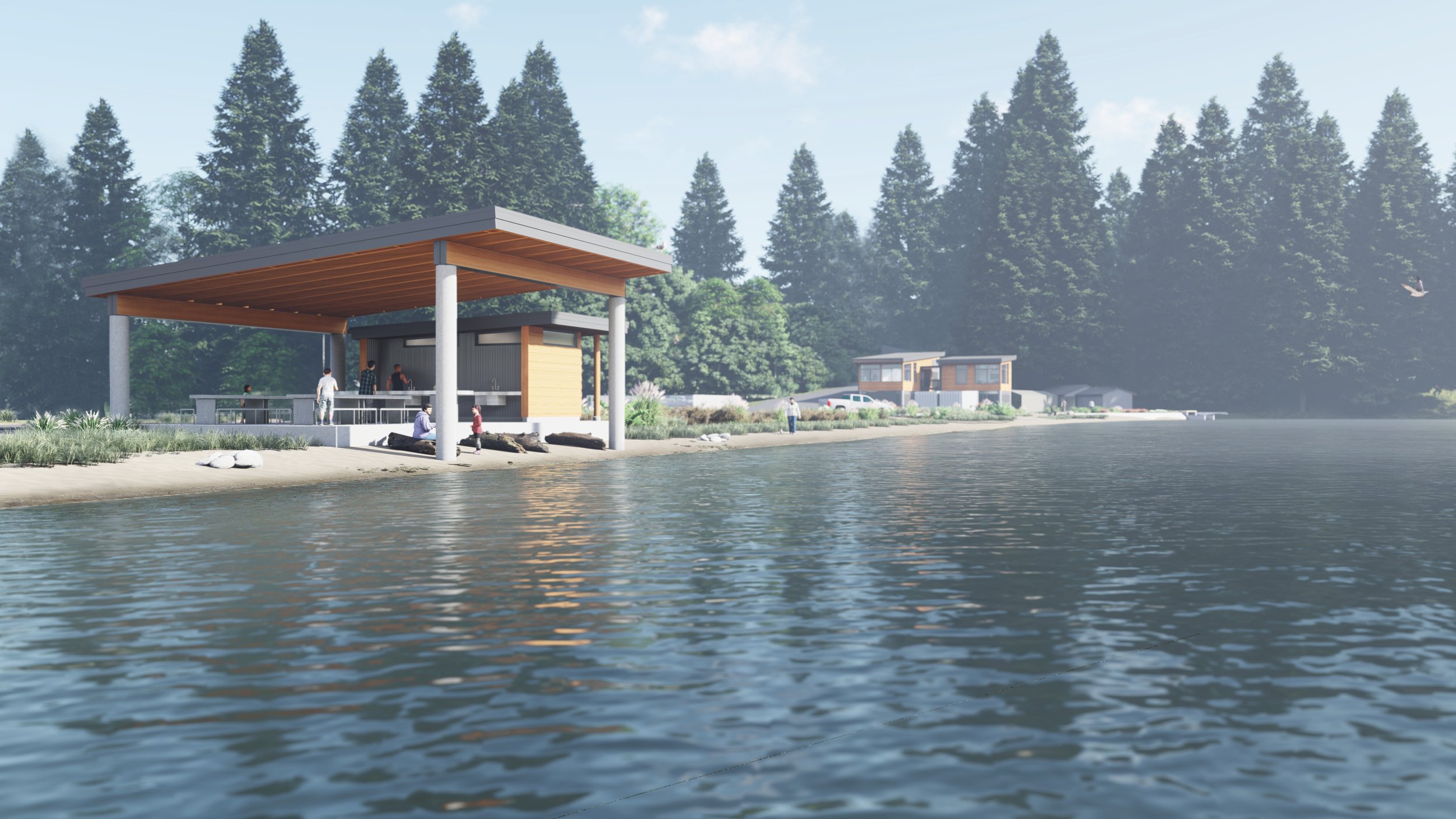
The Port Gamble S’Klallam Tribe Hatchery Building is located on the beach in a known archaeological site. CAST worked closely with the Tribe’s Cultural Resources team to develop an amendment to the Tribe’s Archaeological Resources Protection Act (ARPA) permit and to incorporate the resultant Monitoring and Discovery Plan (MDP) into the project specifications. Located in the intertidal zone, the design required close coordination with Structural and Geo-Technical engineers to ensure that the building will be resistant to higher tide levels predicted to occur with rising sea levels.

rendering of beach shelter, pacific northwest design

Rendering of Port Gamble S’Klallam Tribe Beach Shelter and Hatchery Building in the distance